

Every client asks some version of the same question before they sign:
How close can a team on the other side of the world actually feel?
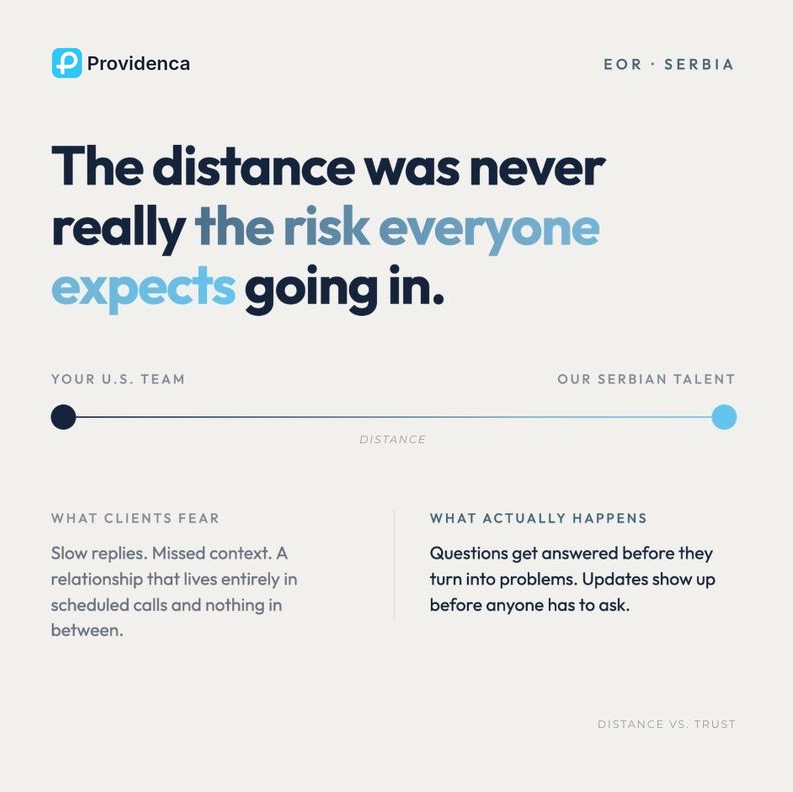
It’s a fair worry. For a long time, distance meant something specific. Slow replies. Missed context. A working relationship that lived entirely in scheduled calls, with nothing in between.
After years of placing Serbian professionals inside U.S. teams, here’s what we’ve seen, partnership after partnership: the distance almost never turns into the problem everyone expects.
What leaders are really worried about
The fear usually isn’t about the work. It’s about visibility.
In Microsoft’s 2022 Work Trend Index, 85% of leaders said hybrid work made it hard to be confident their people were productive. At the same time, 87% of employees said they were. Microsoft called it “productivity paranoia.”
That gap, not the time zone, is what companies are really worried about when they hire abroad. And it can be closed.
Trust is built by behavior, not proximity
Researchers Jarvenpaa, Knoll and Leidner studied 75 global virtual teams and found that trust can form quickly between people who have never met. It’s often called “swift trust.”
Shared office space didn’t build it. Prompt replies and predictable behavior did, and above all, whether people did what they said they would.
That matches exactly what we see in practice.
The shift that happens a few weeks in
Questions get answered before they turn into problems.
Updates show up before anyone has to ask for them.
A joke lands in a Slack thread the same way it would between two people who share an office.
At that point, nobody’s thinking about time zones or maps anymore. It just feels like one team, working toward the same thing.
Why it works so well with Serbian professionals
- English that holds up in real conversations. Serbia is in the “High Proficiency” band of the EF English Proficiency Index. That’s the difference between someone who executes tasks and someone who joins the discussion and pushes back when something doesn’t make sense.
- Long experience with foreign clients. Working remotely across borders was a professional habit here long before 2020.
- Directness. They’ll tell you a deadline is at risk instead of quietly missing it. That’s exactly the integrity signal the research points to.
- Real overlap. Serbia is six hours ahead of U.S. Eastern Time, which leaves enough of the day for stand-ups and live collaboration.
How we set teams up to earn trust from day one
We hire for reliability, not just skills. We screen for communication, ownership and consistency alongside technical ability.
Your people work inside your team. They join your Slack, your stand-ups and your workflows, with no account manager in between.
We handle everything outside the work. Contracts, payroll, compliance and HR in Serbia are covered, so your relationship stays focused on the work.
We stay close to both sides. Small issues get solved while they’re still small.
All of this comes with one flat monthly fee per employee, recruiting included.
The bottom line
The distance was never really the risk. What matters is whether someone shows up the same way, every single time, whether or not you’re watching.
When they do, you stop managing a vendor on the other side of a contract. You start working with colleagues.
Frequently asked questions
Can a remote team in another country really feel like part of my company?
Yes. Research on global virtual teams shows that trust forms through consistent behavior, fast communication and follow-through, not physical proximity.
What is the time difference between Serbia and the U.S.?
Serbia is six hours ahead of Eastern Time and nine hours ahead of Pacific Time, with daily overlap for real-time work.
How good is English in Serbia?
Serbia ranks in the “High Proficiency” band of the EF English Proficiency Index, and most professionals work in English every day.
RECRUITING INCLUDED
See who could join your team from Serbia
Tell us about the role. We’ll send you pre-vetted candidates, and you pay nothing unless you hire.